

Utilizing Department of Energy Loans to Build U.S. Nuclear Projects
The Office of Energy Dominance Financing (EDF) has been instrumental in the commercial deployment of nuclear technology in the United States. This paper provides recommendations to build on that success and fully realize EDF’s potential going forward, especially with respect to investing in early mover technology. NIA believes that in parallel with achieving the critical near-term goals of affordability and reliability, EDF must prioritize innovation investment to lay the foundation for long-term U.S. energy security and competitiveness

NIA submitted a public comment on Nuclear Regulatory Commission Draft Regulatory Guide DG-1443 Comprehensive Risk Metrics and Associated Risk Performance Objectives for Commercial Nuclear Plants.
NIA supports the reasonable approach outlined in the DG-1443 Comprehensive Risk Metrics and Associated Risk Performance Objectives for Commercial Nuclear Plants and encourages NRC to continue to work with stakeholders as the guidance is implemented. The outlined approach is aligned with NIA’s previous work. In particular, in our Comprehensive Risk Metrics for Nuclear Reactor Regulation report, NIA had recommended a flexible, predictable, self-consistent, and
implementable process for applicants to put forward, and for NRC to approve, these risk metrics. Under DG-1443, NRC describes three different approaches that applicants could use. DG-1443 is also responsive to NIA's call for NRC to provide guidance regarding the implementation of the new comprehensive risk metrics.

NIA submitted a comment on the proposed Nuclear Regulatory Commission Modernization: Rulemaking Procedure, Federal Advisory Committee Act (FACA) Alignment, Access, and Security rule issued on August 11, 2025.
NIA has a concern about the proposed rule and the long-term implications. The final rule would revise a procedural requirement related to post-promulgation comment periods. Under current rules, it is mandatory for NRC to have a 30-day public comment period after it promulgates a rule. The proposed change would allow NRC to forgo the comment period at its discretion. NRC cites the mandatory provision as an unnecessary administrative burden.
The proposed rule aims to align the NRC with the U.S. government-wide FACA regulations. If this change is implemented, the NRC needs to ensure there is no conflict with the specific statutory requirements for ACRS in the Atomic Energy Act (AEA). NIA agrees that administrative work does not need to be subject to notice and open meeting requirements and is supportive of this efficiency improvement. However, NIA recommends that NRC more clearly define the line between preparatory activities and substantive discussion to ensure that the ACRS’s collective deliberations remain open to the public.
Fuel Transportation Readiness for New Nuclear Commercialization
As advanced reactor technologies move toward commercialization, the nuclear fuel transportation system will face new demands. Package certification, regulatory adjustments, logistics, and infrastructure are all key elements of a resilient fuel transportation system. Proactively adapting the U.S. fuel transportation system to the demands of new fuels and reactor types is necessary for successful reactor deployment.
Transportation readiness is a condition for successful commercialization. Fuel transportation has historically been a well-managed part of the nuclear fuel cycle, supported by rigorous oversight and coordination across federal agencies, state and local governments, and private industries. That same coordination is essential as advanced reactor designs move from demonstration to commercialization. The transportation system and the regulations governing it must evolve together, and no single entity can drive that evolution alone.
New Nuclear Reactors for Military Purposes
The U.S. government has substantial efforts underway to develop new nuclear reactors for military purposes. Recent executive orders, together with congressional mandates, establish a coordinated strategy that links national security with mission assurance.
This updated NIA publication outlines the federal policy framework and the projects, concepts, and solicitations underway to translate policy direction and statutory authority into operational capability. It further provides a comprehensive guide to the concepts and initiatives the government is pursuing to develop new nuclear reactors for military purposes.
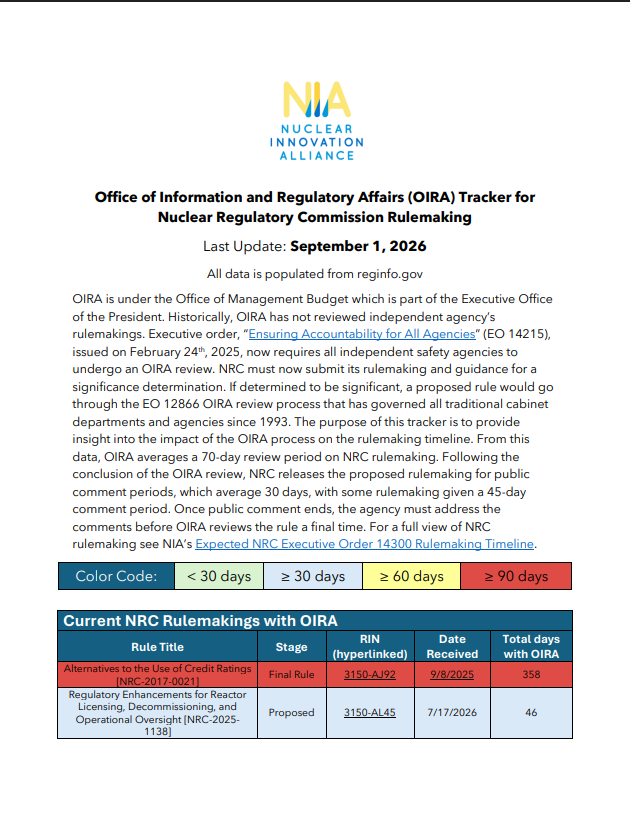
The Office of Information and Regulatory Affairs (OIRA) is under the Office of Management Budget, which is part of the Executive Office of the President. Executive order, “Ensuring Accountability for All Agencies” (EO 14215), issued on February 24th, 2025, requires all independent safety agencies to undergo an OIRA review. The Nuclear Regulatory Commission (NRC) must now submit its rulemaking and guidance for a significance determination. If determined to be significant, a proposed rule would go through the EO 12866 OIRA review process that has governed all traditional cabinet departments and agencies since 1993. The purpose of this tracker is to provide insight into the impact of the OIRA process on the rulemaking timeline. Originally published in May of 2026, this resource is updated as new information becomes available.
This factsheet was last updated in September 2026.
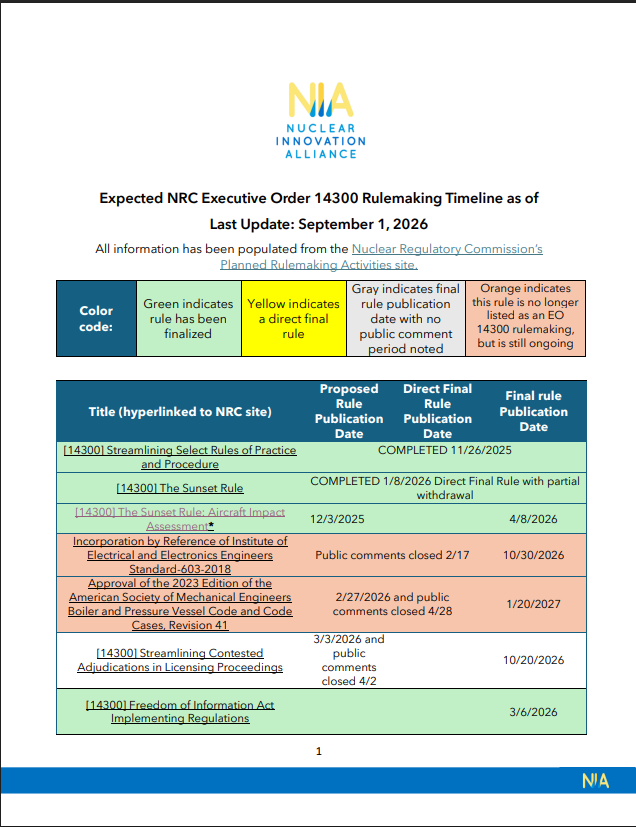
Expected NRC Executive Order 14300 Rulemaking Timeline
This NIA factsheet highlights the expected timeline of the NRC Executive Order 14300 Rulemaking. This timeline helps to provide a quick view of the individual rulemakings populated from the NRC website. Originally published in December of 2025, this resource is updated as new information becomes available.
This factsheet was last updated in September 2026
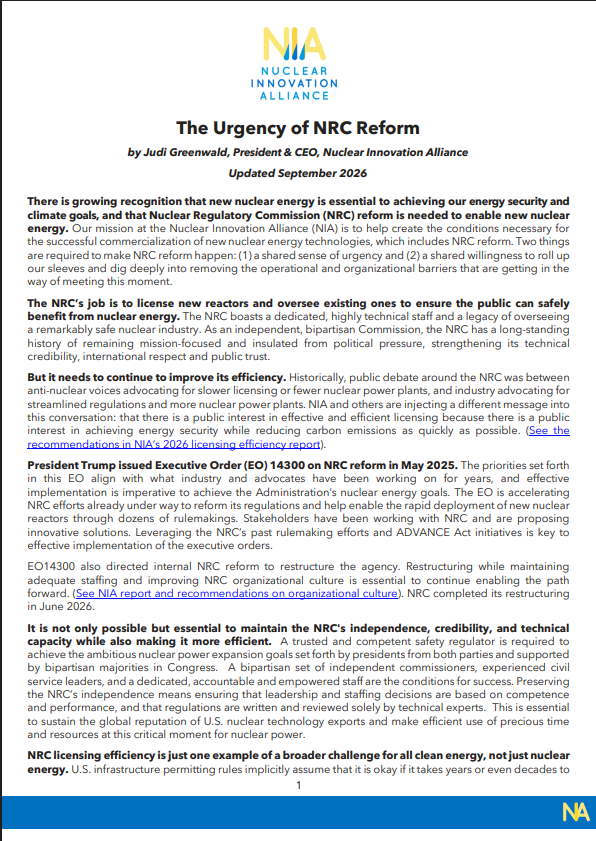
The Urgency of NRC Reform
This brief connects the role of advanced nuclear energy in meeting climate and energy security goals with the urgent need for NRC reform to enable advanced nuclear energy. It outlines the short-, medium- and long-term NRC reforms that are necessary to achieve that goal. It provides recommendations for action by Congress and the NRC and highlights several of NIA's recommendations for improving licensing efficiency. NIA developed this brief to serve as a guide for policymakers, the NRC itself, and key stakeholders in considering and then taking action to ensure the NRC can successfully meet this moment.
This brief was last updated in September 2026
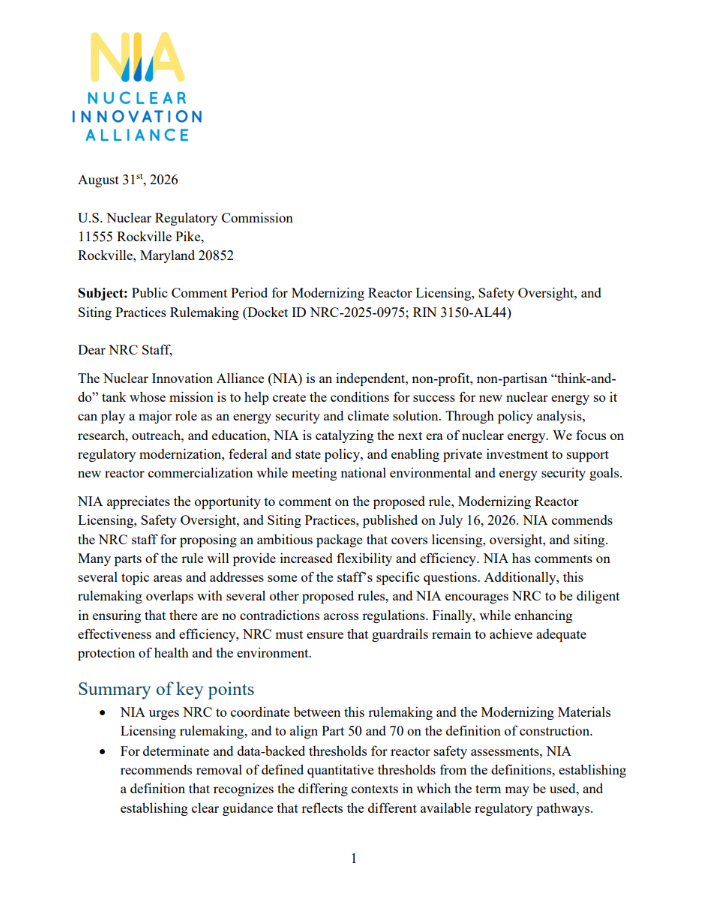
NIA submitted a public comment on the proposed rule, Modernizing Reactor Licensing, Safety Oversight, and Siting Practices. NIA has comments on several topic areas and addresses some of the staff’s specific questions. Additionally, this rulemaking overlaps with several other proposed rules, and NIA encourages NRC to be diligent in ensuring that there are no contradictions across regulations. Finally, while enhancing effectiveness and efficiency, NRC must ensure that guardrails remain to achieve adequate protection of health and the environment.
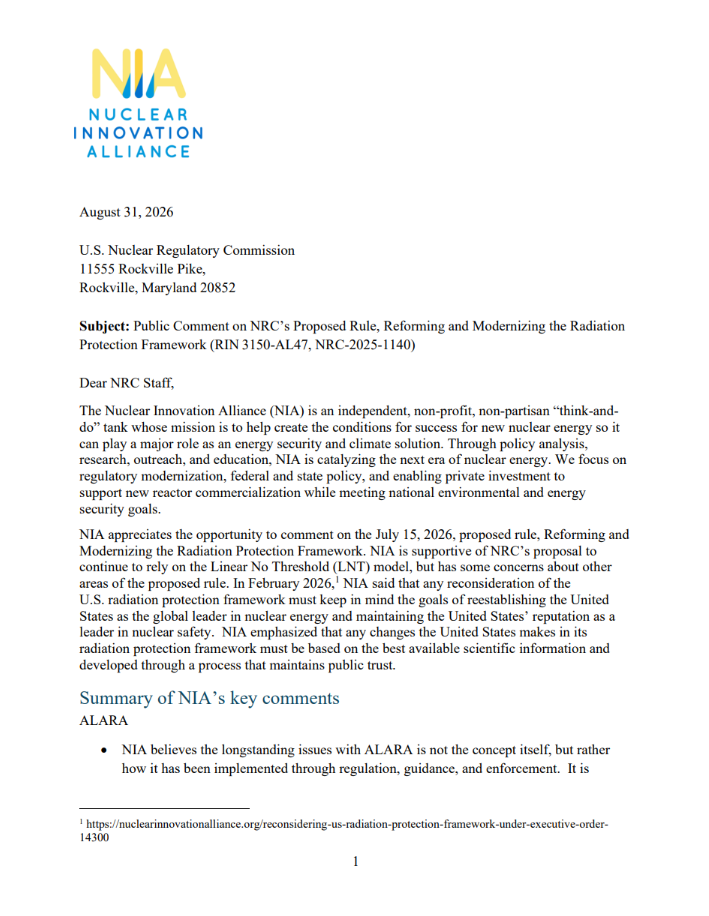
NIA submitted a public comment on RC’s Proposed Rule, Reforming and Modernizing the Radiation Protection Framework. NIA is supportive of NRC’s proposal to continue to rely on the Linear No Threshold (LNT) model, but has some concerns about other areas of the proposed rule. In February 2026, NIA said that any reconsideration of the U.S. radiation protection framework must keep in mind the goals of reestablishing the United States as the global leader in nuclear energy and maintaining the United States’ reputation as a leader in nuclear safety. NIA emphasized that any changes the United States makes in its radiation protection framework must be based on the best available scientific information and developed through a process that maintains public trust.